Retailers Must Recognise Dramatic Increase in Production Costs

Since last summer increased feed costs alone could wipe out 66% of net farm income on Northern Ireland farms - “The food chain must respond with increased prices if our livestock industry is to survive.” This was the stark message from NI Grain Trade Association President, Declan Billington when he met the Ulster Farmers Union this week .
He pointed out that feed material costs have risen by £80 per tonne since last spring -, an increase of 60% or more on most materials and while forward contracts have shielded the farmer to some extent the full impact of these high prices will be felt before turn out in March/ April.
Factors driving the feed price increase include the growing demand for food from global population growth, particularly in the developing countries.
India and China are commanding more of the worlds resources, as is the global energy industry – consuming vast quantities of grain and potential feed materials for fuel and for ethanol production. The weakness of sterling against both the euro and US dollar and the activity of financial institutions which see food production as a safe home for their investment funds.

Against this background the failure of the grain harvest in any part of the world can send the markets into a spin. Drought and a poor crop in Eastern Europe caused some countries to suspend wheat exports and triggered the current price surge. Concerns about the harvest in the Southern Hemisphere and the floods in Australia will mean that any reduction in grain prices is unlikely for some time.

“The degree of volatility we are seeing is unprecedented” said Declan. “ In December it looked as if an increase of £15 per tonne in January and another £18 at turnout would be necessary. The market has changed so much over the Christmas break that the increase of £15 in January needs to be followed by an increase of £30 before turnout. This shows how quickly these markets are moving and they are showing no signs that we are at the peak.
“The impact on production costs at farm level is dramatic - by April we would predict that the cost of producing a pig will have increased by 40 pence per kg since last summer - while poultry will have 40 to 50 pence per bird added cost on broilers and 20 pence per dozen on eggs. For the beef farmer the impact is 40 pence per kg on an intensive beef animal while the dairy farmer will have an added cost of 3 pence per litre on milk.”

Declan concluded “If retailers wish to maintain a production base of locally grown, fresh, quality assured food they must respond with a realistic price which reflects the cost of production. Reliance on imports is dangerous in a world where the major food producing countries are retaining more of their output and the developing countries are so aggressive in building their food stocks.”
NIGTA pledged their support for the producer organisations in the campaign for an urgent and effective response from the entire food chain to the current escalation in production costs.
A competition to introduce some lighter moments into the Northern Ireland Grain Trade Association's December meeting provided much food for thought in addition to some hilarious moments.

'Grain Trade member Peter Davison was the winner of the NIGTA Name the baby competition, where you had to guess names and put captions to photographs of members as children. Peter is pictured getting his prize from Declan Billington, President, NIGTA.
Those present received competition sheets illustrating four members when they were babies and were asked to name them and to provide captions. While Alan Ashenhurst, John Thompson and Sons; Robin Irvine Fane Valley; Alan Bristow, Devenish Nutrition and Claudine Heron, W and R, Barnett provided attractive baby photos they were not always easily recognised and the witty captions gave photographer, Columba O'Hare, who judged the competition, an onerous task. The eventual winner was Peter Davison from James Tolland and Co. and he was presented with his gift by Declan Billignton, President of NIGTA.
NIGTA Christmas Lunch 2010


Feed material prices, GMOs, , risk based sampling and the nitrates proposals were some of the topics discussed by the Northern Ireland Grain Trade Association with Jim Nicholson MEP at a meeting this week.

Commissioner Dalli’s announcement on the cultivation of GMO crops allows member states to have their whole country or a particular zone in their country designated as GM free if they wish. The question for farmers is if GM free would return the premium required or if GM regions would have a competitive advantage. It is also felt that the same ruling could be applied to imports of GM feed materials.
Zero tolerance will be even more important as importing GM free from a country that also has a GM area provides a possible risk of contamination. Zero tolerance is also important regarding the importation of not yet authorised GM events into the EU.
A letter from the European feed assocation, FEFAC, and EU feed chain partners calling for the adoption of a technical solution for the low level presence of such GM events has been sent to Commissioner Dalli and Jim Nicholson was asked to give this his full support.
The NIGTA delegation outlined the various factors affecting feed material prices resulting in sharp increases in price. These included the perceived harvest predictions in various parts of the world, and the effects of the bio fuel industry but causing most volatility is fund buying.

The efforts being made by NIGTA to introduce risk based sampling in order to avoid another feed scare like the dioxin scare and to ensure safer feed and thus food for the consumer were commended by Jim Nicholson.
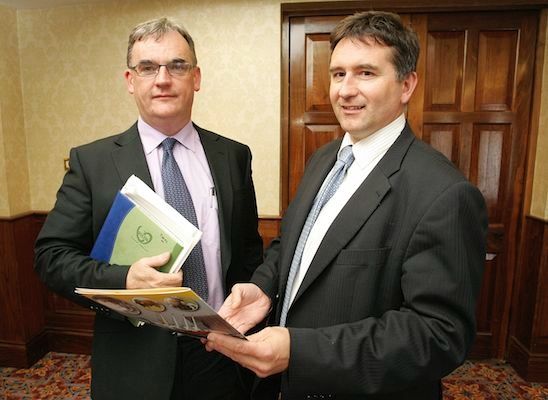
NIGTA delegates, back row, Fiona McCord; John Cunningham; Alan Bristow and Robin Irvine with Declan Billington, front left, President, NIGTA who met with Jim Nicholson MEP , front right, to discuss a range of topics that are of concern at the moment.
NIGTA delegates, back row, Fiona McCord; John Cunningham; Alan Bristow and Robin Irvine with Declan Billington, front left, President, NIGTA who met with Jim Nicholson MEP , front right, to discuss a range of topics that are of concern at the moment.
Under the nitrates proposals it was noted that some of items are of concern to farmers, yet the evidence shows that the current proposals have had a beneficial effect. The Rose Energy project and its importance in putting Northern Ireland well ahead of target under the Nitrates Action Programme was also discussed.
Declan Billington, NIGTA President commented “ We were delighted to learn that Jim Nicholson is very much up to speed with the items discussed and is working very hard not only on aspects which concern the grain and feed trade but also for the agri food industry generally.”
Speaking after the meeting with NIGTA, Conservatives and Unionists MEP Jim Nicholson said, “I would like to thank the representatives from NIGTA for agreeing to meet with me and very much welcome the extremely positive and constructive discussion we had. As I stressed during the meeting, we need greater flexibility and speed in approving GMO imports to Europe because the current situation is untenable particularly for the intensive sector. Because a number of Member States repeatedly abstain on Council when votes regarding GMO authorisation take place the entire approval process is being subject to delays which is unsustainable in the long term.”
The past three weeks have been marked by a significant increase in international wheat and other feed commodity prices.
“The wheat market has strengthened by £25 per tonne during this period,” confirmed Northern Ireland Grain Trade Association Immediate Past President Garth Boyd.
“Normally one would expect other feed materials prices to follow this trend. And this is now happening. Distillers, Citrus, Hulls, Maize, Palm Kernel, Gluten and Pollard prices have all risen over the past number of days. The average increase across this basket of commodities is in the region of £15 per tonne.”
He continued:
“On the protein side the Soya market has remained unchanged while rapeseed prices have increased by £19 per tonne. This latter figure can be partly explained by the recent fire-related loss of a European crushing plant with a 900,000 tonne annual capacity.”
Garth Boyd went on to point out that uncertainty about the outcome of the 2010 harvest is at the heart of the recent trends witnesses on the world’s grain and feed commodity markets.
“Investment houses have also taken positions, particularly with regard to wheat futures, over recent weeks. And where these institutions lead the markets tend to follow,” he further explained.
“The recent floods in Eastern Europe allied to the very warm and dry conditions in the South of the Continent have forced analysts to downsize the size of the this year’s EU wheat crop by 30 million tonnes, compared with 2009. The poor Spring planting conditions in Canada have added to the current concerns about the magnitude of global wheat stocks over the coming months.”
Garth Boyd continued:
“The reality is that most of Europe’s animal feed manufacturers and bio-ethanol producing companies now trade short when it comes to sourcing the raw materials they need for their businesses. And I know that most local feed compounders have very little long term cover at the present time.”
He concluded:
“At some stage in the very near future we will all have to enter the market to source the commodities we need for the 2010/11 feeding season. And this is why the recent hike in cereal and other commodity prices could have such an important bearing on the compound feed trade here in Northern Ireland next winter.
“Local feed companies had to raise their compound prices at the end of June. But this increase was prior to the significant strengthening of the commodity markets that we have witnessed over recent days!”
by: Richard Halleron
Grain Trade Welcomes Temporary Relaxation of Drivers Hours Regulations, on Animal Welfare Grounds

Animal feed suppliers have welcomed the temporary relaxation of the enforcement of drivers’ hours and working time rules.
Declan Billington, President of the NI Grain Trade Association and Chief Executive of John Thompson and Sons said “ NIGTA members have been working in close partnership with their hauliers to ensure that livestock don’t go hungry in these difficult conditions.”
He went on to state that in some of the more difficult terrain, farmers have been forced to meet the delivery lorries at the most accessible part of the farm boundary, with a trailer for the lorry to blow into, or taking feed in bags, while others have spent many long hours is sub zero temperatures been clearing laneways to allow feed lorries and milk tankers to access to the farm.
“Given the dependence of pig and poultry farms on compound feed it has truly been an industry wide team effort, with companies like Moy Park sending salt, grit and shovels out with the delivery lorries and, in the worst hit areas, have salting teams out in force supporting the overstretched farmer” he added.

A spokesperson for Moypark pointed out ”When you consider that we need to move some 6500 tonnes of feed per week across our farming base in Northern Ireland this has been a major challenge. Our dedicated haulage partner, Capper Trading, has been doing sterling work with well equipped teams standing shoulder to shoulder with the farmer, clearing difficult roads and tribute must be paid to those teams and to the farmer in going that extra mile to protect the welfare of the livestock.
Declan Billington added “ The temporary relaxation on drivers hours will help the industry get back on track with building enough stock in the country to ensure farms get through this Christmas without experiencing any shortages. The pre-Christmas period is always very busy as we deliver extra feed to tide farms over the holiday period.”
An update on the Rose Energy biomass plant was the subject at the Northern Ireland Grain Trade Association’s quarterly meeting.

Osvaldo Mauro-Hun, Chief Executive, outlined the benefits of the scheme, not only for the poultry industry, but for the entire agri food industry and for jobs in Northern Ireland. The poultry industry is Northern Ireland’s second biggest industry and accounts for around 7,000 jobs. The environmental benefits were also emphasised as the plant will help Northern Ireland to meet the dictates of the European Nitrates Directive.
Osvaldo said “We have spent over six years researching and developing our proposals and have worked with planning and environmental experts to ensure that our planning application is robust and thorough. We look forward to now making our plans a reality and securing the future of the local agrifood industry.”
He went on to point out that similar plants have been operating in America and England for many years with no adverse effects on public health, farming or the environment.
Osvaldo concluded: “We welcome the government’s recent announcement of its intention to approve the Rose Energy plant. This is a win-win project and has received widespread support from across the agri and business sectors as such.”
Rose Energy Meeting September 2010
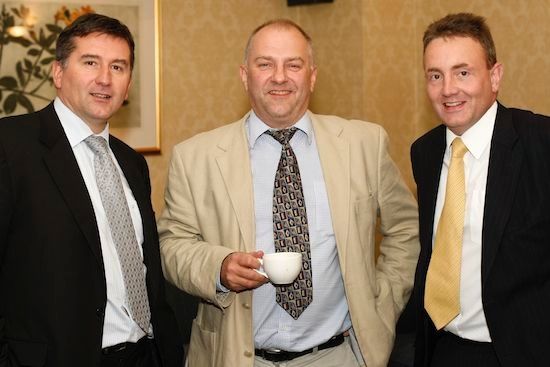
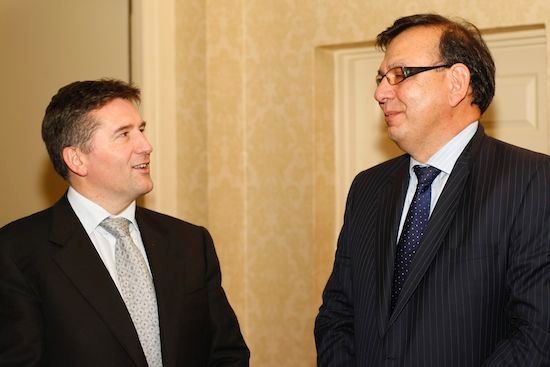
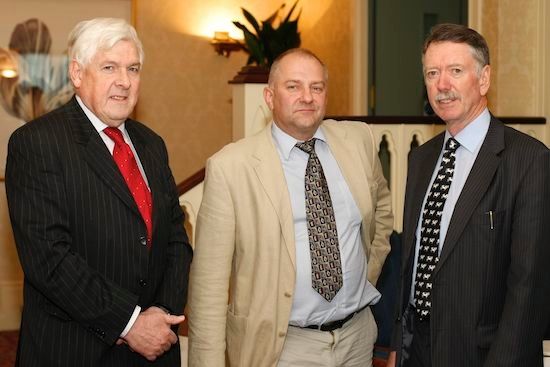

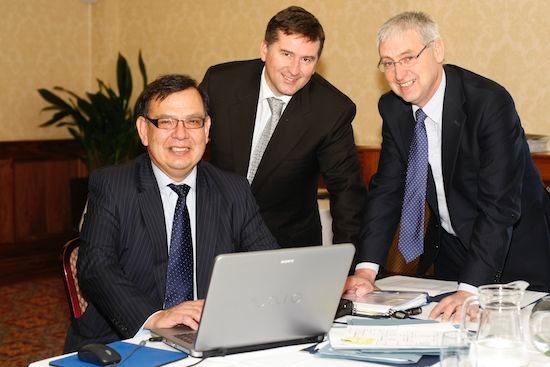
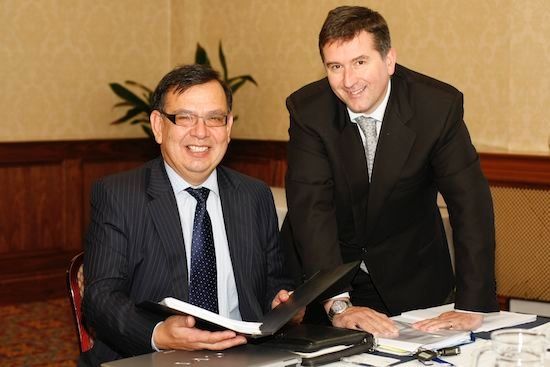
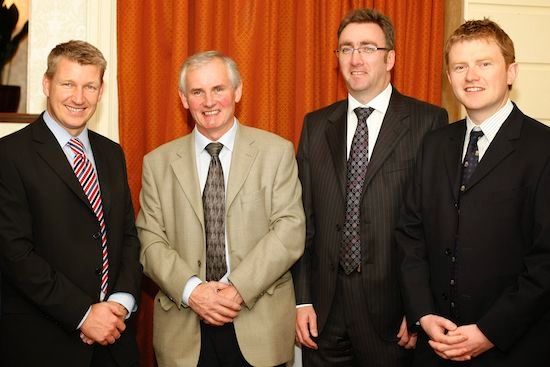
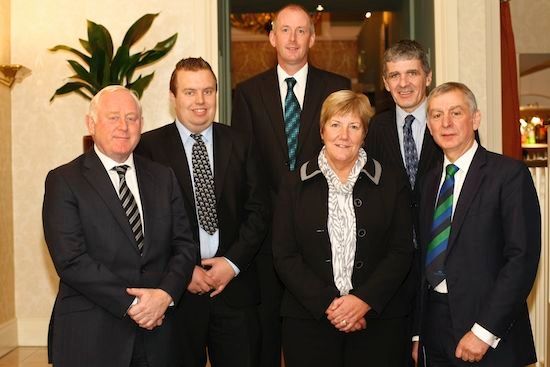




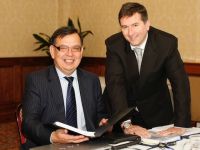


Purchasing protocols in the food processing industry must change according to Seamus Carr, Managing Director of Vion, Cookstown when he spoke at a recent meeting of the NI Grain Trade Association.

Seamus told the meeting that the company had suffered significant commercial damage from the dioxin incident with helpful but limited recovery from the NI Hardship Scheme from government. He pointed out that only a company with the global strength of Vion who operate in GB, Irish and European markets, could have withstood the financial impact – a small family firm would have been wiped out.
He said “Food processors need to work more directly with their primary supply chain to identify risks and manage them out. Insurance companies are now querying due diligence within the supply chain and the details of supplier contracts. We have to have rigorous quality assurance throughout the food chain
to eliminate risks and bad practise.”
Seamus went on to outline the company’s activities stating that Vion is a farmer’s co-op owned by 18,000 Dutch farmers. Their Cookstown operation processes 21,000 pigs peer week with 12,000 coming from the North and 9,000 from the south. The turnover in the Cookstown business is circa £150 million with 650 employees. Efficiency of scale at 530 pigs killed per hour is necessary in today’s competitive environment .
He commented on the efficiency of the farmers who supply the plant stating that not many years ago 19 to 21 pigs per sow per year was considered a high on-farm throughput but now some farmers are achieving 26 to 30 pigs per sow per year.

Vion would like to see less variation in the quality of pigs but also stated that there was clearly an onus on processors to work with pig farmers to bring this about.
Commissioner Dalli’s announcement on the cultivation of GMO crops allows member states to have their whole country or a particular zone in their country designated as GM free if they wish. The question for farmers is if GM free would return the premium required or if GM regions would have a competitive advantage. It is also felt that the same ruling could be applied to imports of GM feed materials.
Zero tolerance will be even more important as importing GM free from a country that also has a GM area provides a possible risk of contamination. Zero tolerance is also important regarding the importation of not yet authorised GM events into the EU.
A letter from the European feed assocation, FEFAC, and EU feed chain partners calling for the adoption of a technical solution for the low level presence of such GM events has been sent to Commissioner Dalli and Jim Nicholson was asked to give this his full support.
The NIGTA delegation outlined the various factors affecting feed material prices resulting in sharp increases in price. These included the perceived harvest predictions in various parts of the world, and the effects of the bio fuel industry but causing most volatility is fund buying.
The efforts being made by NIGTA to introduce risk based sampling in order to avoid another feed scare like the dioxin scare and to ensure safer feed and thus food for the consumer were commended by Jim Nicholson.
Under the nitrates proposals it was noted that some of items are of concern to farmers, yet the evidence shows that the current proposals have had a beneficial effect. The Rose Energy project and its importance in putting Northern Ireland well ahead of target under the Nitrates Action Programme was also discussed.
Declan Billington, NIGTA President commented “ We were delighted to learn that Jim Nicholson is very much up to speed with the items discussed and is working very hard not only on aspects which concern the grain and feed trade but also for the agri food industry generally.”
Speaking after the meeting with NIGTA, Conservatives and Unionists MEP Jim Nicholson said, “I would like to thank the representatives from NIGTA for agreeing to meet with me and very much welcome the extremely positive and constructive discussion we had. As I stressed during the meeting, we need greater flexibility and speed in approving GMO imports to Europe because the current situation is untenable particularly for the intensive sector. Because a number of Member States repeatedly abstain on Council when votes regarding GMO authorisation take place the entire approval process is being subject to delays which is unsustainable in the long term.”
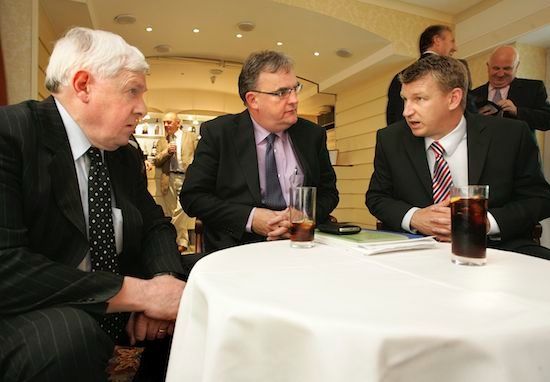
Vion Meeting June 2010





Global disruption in the supply of feed materials is providing major challenges for local animal feed suppliers, with the late spring keeping demand very strong and severe logistical problems affecting the availability of some key ingredients. As a result feed firms are struggling to source their raw material requirements.
This inevitably keeps prices strong and the trade is facing substantially higher costs to ensure supplies for the coming weeks.
Declan Billington, President of the NI Grain Trade Association commented “ We are hopeful that these difficulties will be short term and we are aiming to absorb the extra costs and hold current feed prices as we do not wish to add to the hardship faced by farmers due to the recent severe weather conditions, especially at a time when they should be able to improve margins due to higher product prices.”
According to Declan, many companies are coming out of their cheaper winter raw material book to face the “gathering storm” of weakening sterling, strikes in Argentina, the alternative “biomass markets” and late turnout of stock, which have all kept materials stubbornly high.
The strikes in Argentina have delayed soya and soya hulls cargos while the biomass markets have put a floor in cereal replacer prices. The late turnout of stock and continued meal feeding has left feed firms chasing scarce materials up and down the length of Ireland.
Looking forward the NIGTA President noted that feed firms are now having to “bite the bullet” and lock in at high prices for the next few months, simply to ensure that material is physically available for spring turnout. With the volatility that remains in currency, commodities and weather, the next few months could remain challenging. However on a more positive note he also believed that as we move past these difficult spring positions, the intensive high soya, high cereal diets may, based on current forward prices/ exchange rates, provide some cost relief as the summer progresses.
Credit Squeeze
He went on to say that even assuming enough cover is taken to supply the market for the next few months, he still had concerns about the farmer’s ability to pay.
“With the banking squeeze on credit at farm level, the feed industry is being challenged to support customers during these difficult times and their ability to provide credit is being stretched more and more” he said. “ The feed industry banks with the same banks as our customers. Moving debt from the farmers bank facilities to our own is driving the industry in the wrong direction. What the industry needs most over the next few months is for the banks to provide sufficient support for farmers to enable them to restore the fertility, health and the potential milk yield of their herds at a time when milk prices are improving.
This spring will bring opportunities for profitable milk production for those who can invest in their cows and maximise production. The ratio of feed price to milk price is currently very favourable and extra litres will add profit to the bottom line. This can only be achieved by businesses that are adequately funded and able to meet their commitments”.
Declan continued “Through maximising use of forage alongside concentrate (which will require up front investment in fertilizer) farmers can make a real difference to their bank balances. The secured lenders can have a key part to play in this recovery and we would encourage them to support their customers efforts to improve profitability over the summer months.”
- You are here:
-
Home

- NEWS-UPDATE